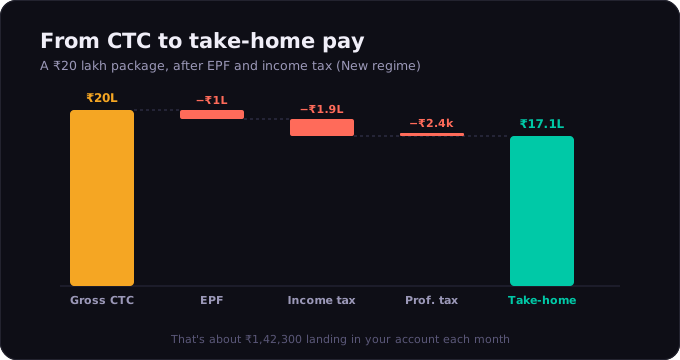
Your Cost to Company (CTC) is not your take-home pay. Not even close. For many Indian salaried employees, the gap between CTC and actual in-hand salary can be 20–35%. This guide explains every deduction that stands between your headline salary and the amount that hits your bank account.
CTC vs Gross Salary vs Net Salary
These three terms are often confused:
- CTC (Cost to Company): Everything the company spends on you — your salary, employer EPF contribution, gratuity provision, insurance, perks. This is what the offer letter usually quotes.
- Gross Salary: What you earn before deductions — basic, HRA, allowances. Does NOT include employer EPF or most perks.
- Net Salary / In-Hand: Gross salary minus employee EPF, Professional Tax, and TDS (income tax withheld). This is what you actually receive.
Understanding the Salary Slip Structure
A typical Indian salary slip has two sides:
Earnings (Additions)
- Basic Salary: Usually 40–50% of CTC. This is the foundation — EPF is calculated on basic, HRA is calculated on basic, gratuity is based on basic.
- House Rent Allowance (HRA): Typically 40–50% of basic. Can be partially or fully exempt from tax under the Old Regime.
- Special Allowance: A flexible component that makes up the remainder. Fully taxable in both regimes.
- Other Allowances: LTA (tax-exempt under Old Regime if used for travel), food coupons, phone reimbursement, etc.
Deductions (Subtractions)
- Employee PF (EPF): 12% of basic salary (statutory wage limit: ₹15,000/month). Max monthly employee deduction: ₹1,800. Annually: ₹21,600.
- Professional Tax: State-specific. Maharashtra charges ₹200/month (₹2,400/year) for salary above ₹10,000. No PT in some states.
- TDS (Tax Deducted at Source): Your employer withholds income tax monthly. The amount depends on your chosen regime and submitted proofs.
EPF: The Statutory Wage Cap Confusion
EPF (Employees' Provident Fund) is probably the most misunderstood part of the salary. Here's what actually happens:
- Employee contributes 12% of basic salary (or ₹15,000 — whichever is lower). If your basic is ₹30,000/month, your mandatory employee EPF is ₹1,800/month (12% of ₹15,000), not ₹3,600.
- Employer matches 12% of basic. But the employer's 12% is split: 3.67% goes to EPF, 8.33% goes to EPS (Employee Pension Scheme).
- Companies often show employer EPF in your CTC, so your CTC can appear higher than your gross salary by ~12% of basic.
- Voluntary PF (VPF) lets you contribute more than 12% voluntarily. It earns the same EPF interest rate (currently 8.25%) and is deductible under 80C (Old Regime).
TDS: How Your Employer Calculates It
Your employer projects your annual income at the start of the financial year and divides the estimated tax liability by 12 to deduct monthly. If you declare investments and allowances, TDS will be lower. Here's the process:
- At the start of the year, you declare your investment plans (80C, 80D, HRA receipts) to your HR/payroll team.
- Your employer calculates estimated annual tax and divides by 12.
- If you under-declare investments, TDS is higher — you get a refund when you file returns.
- If you over-declare investments you don't actually make, TDS is lower — but you'll owe more when filing.
Worked Example 1 — ₹6 Lakh CTC (Entry Level)
| Basic (40% of gross) | ₹2,40,000/yr |
| HRA (50% of basic) | ₹1,20,000/yr |
| Special Allowance | ₹1,40,000/yr |
| Gross Salary | ₹5,00,000/yr |
| Employer EPF (in CTC) | ₹21,600/yr |
| CTC | ~₹5,21,600/yr |
| Employee EPF (−12% of ₹15K×12) | −₹21,600/yr |
| Professional Tax | −₹2,400/yr |
| TDS (New Regime, ₹5L − ₹75K std = ₹4.25L → 87A rebate = ₹0 tax) | −₹0 |
| Annual Take-Home | ₹4,76,000 |
| Monthly In-Hand | ~₹39,667/mo |
Worked Example 2 — ₹12 Lakh CTC (Mid-Level)
| Basic (40%) | ₹4,00,000/yr |
| HRA (50% basic) | ₹2,00,000/yr |
| Special Allowance | ₹3,40,000/yr |
| Gross Salary | ₹9,40,000/yr |
| Employer EPF (CTC portion) | ₹21,600/yr |
| Employee EPF | −₹21,600/yr |
| Professional Tax | −₹2,400/yr |
| TDS (New Regime: ₹9.4L − ₹75K = ₹8.65L, tax ≈ ₹26,250, 87A rebate → ₹0) | −₹0 |
| Annual Take-Home | ₹9,16,000 |
| Monthly In-Hand | ~₹76,333/mo |
Worked Example 3 — ₹20 Lakh CTC (Senior)
| Basic (40%) | ₹6,00,000/yr |
| HRA | ₹3,00,000/yr |
| Special Allowance | ₹7,70,000/yr |
| Gross Salary | ₹16,70,000/yr |
| Employer EPF + gratuity (CTC) | ~₹1,30,000/yr |
| Employee EPF | −₹21,600/yr |
| Professional Tax | −₹2,400/yr |
| TDS (New Regime: ₹16.7L − ₹75K = ₹15.95L taxable → ~₹1,11,250 + 4% cess ≈ ₹1,15,700) | −₹1,15,700/yr |
| Annual Take-Home | ₹15,30,300 |
| Monthly In-Hand | ~₹1,27,525/mo |
Tips to Maximise Your Take-Home
- Choose the right regime: For most salaries under ₹20L without major deductions, the New Regime is now better.
- Claim HRA if renting: Under the Old Regime, HRA exemption can significantly reduce taxable income. Keep rent receipts and landlord PAN if rent exceeds ₹1L/year.
- Use NPS for extra deduction: Section 80CCD(1B) gives ₹50,000 extra deduction (Old Regime only) beyond the ₹1.5L 80C limit.
- Salary restructuring: Flexible benefit plans (meal cards, fuel allowance, phone reimbursement) can be structured to reduce tax under the Old Regime. Many companies offer this flexibility.
- Declare investments on time: Submit your investment declarations in April — early declaration means lower TDS throughout the year (better cash flow), even if the total tax is the same.
See your exact take-home in seconds
Enter your salary, regime preference, and deductions — get annual and monthly in-hand in one click.
Open Take-Home Pay Calculator →Frequently Asked Questions
Source: EPFO, Income Tax Department India. FY 2026-27. Not financial advice.
Official sources
Every rate and threshold in this guide is checked against the official government sources below. Always confirm figures for your own situation before filing.