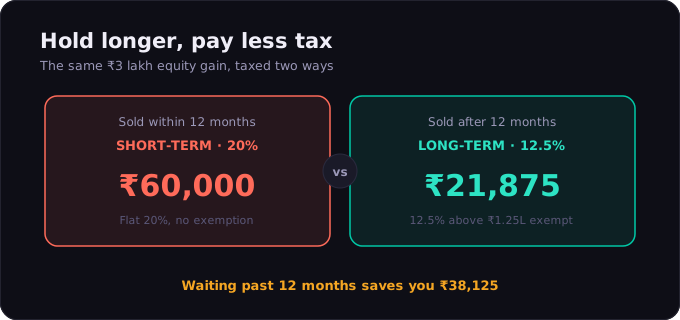
Budget 2024 made significant changes to capital gains taxation in India that every investor needs to understand. Short-term capital gains on equity were raised from 15% to 20%. Long-term capital gains on equity kept the 10% rate but the exemption limit stayed at ₹1.25 lakh. Property gains moved to a flat 12.5% — but indexation (the inflation adjustment benefit) was removed. Here's the complete picture.
Budget 2024 Changes at a Glance
- STCG on listed equity / equity MF: raised from 15% → 20%
- LTCG on property: removed indexation benefit; flat rate now 12.5%
- LTCG on equity: rate stayed at 10%, but exemption raised to ₹1.25 lakh
- Holding period for LTCG on unlisted shares: changed from 36 months to 24 months
Short-Term vs Long-Term: Holding Periods
| Asset Type | LTCG Threshold | STCG Rate | LTCG Rate |
|---|---|---|---|
| Listed equity shares / Equity MF | 12 months | 20% | 10%* |
| *exempt up to ₹1.25L per year | |||
| Immovable property (land/building) | 24 months | Slab rate | 12.5% |
| Unlisted shares | 24 months | Slab rate | 12.5% |
| Debt MF / Bonds (post Apr 2023) | N/A | Slab rate (always) | |
4% Health & Education Cess applies on all capital gains tax. Surcharge may apply on high gains.
Worked Example 1 — LTCG on Equity Mutual Funds
Scenario: Invested ₹5,00,000 in equity mutual fund 2 years ago. Current value ₹8,00,000. Gain = ₹3,00,000.
Long-term gain (held 12+ months): ₹3,00,000
Exemption: ₹1,25,000
Taxable LTCG: ₹3,00,000 − ₹1,25,000 = ₹1,75,000
Tax at 10%: ₹17,500
4% Cess: ₹700
Total CGT = ₹18,200
Worked Example 2 — STCG on Stocks
Scenario: Bought shares for ₹2,00,000 in February, sold in August for ₹2,70,000. Held less than 12 months. Gain = ₹70,000.
STCG rate: 20%
Tax: ₹70,000 × 20% = ₹14,000
4% Cess: ₹560
Total CGT = ₹14,560
Note: The ₹1.25L exemption does NOT apply to STCG.
Worked Example 3 — LTCG on Property (Post Budget 2024)
Scenario: Bought flat in 2018 for ₹40,00,000. Sold in 2025 for ₹75,00,000. Held 7 years (qualifies as LTCG).
Pre-Budget 2024 (with indexation):
Cost Inflation Index 2018-19 = 280, 2024-25 = 363.
Indexed cost = ₹40L × (363/280) = ₹51,86,000
LTCG = ₹75L − ₹51.86L = ₹23,14,000. Tax at 20% = ₹4,62,800
Post-Budget 2024 (no indexation, 12.5%):
LTCG = ₹75L − ₹40L = ₹35,00,000. Tax at 12.5% = ₹4,37,500
In this case, new regime saves ₹25,300 — but for properties held very long or with high inflation, old indexation could have been better.
Note: For properties bought before July 23, 2024, a transitional provision allows you to choose between 20% with indexation and 12.5% without, for properties held before that date.
Section 54: LTCG Exemption on Reinvestment
You can avoid LTCG tax on property if you reinvest the gains:
- Section 54: Reinvest LTCG from one residential property into another residential property (buy 1 year before or 2 years after sale, or construct within 3 years). Max exemption for 2 houses if gain ≤ ₹2 crore (one-time option).
- Section 54EC: Invest LTCG in specified bonds (NHAI, REC) within 6 months of sale. Max ₹50 lakh per year. Lock-in: 5 years.
- Section 54F: Reinvest entire sale proceeds (not just gains) from any long-term asset (not property) into a residential house.
Tax-Loss Harvesting in India
Capital losses can be set off against capital gains:
- Short-term capital loss can be set off against both STCG and LTCG.
- Long-term capital loss can only be set off against LTCG — not against STCG.
- Unabsorbed losses can be carried forward for 8 assessment years.
At the end of March each year, many investors book losses strategically to offset gains. If you have LTCG of ₹5L and LTCL of ₹2L, your taxable LTCG is only ₹3L (then apply ₹1.25L exemption → taxable ₹1.75L).
Surcharge on Capital Gains
High gains also attract surcharge. For LTCG under Section 112A (equity) and STCG under Section 111A (equity), the maximum surcharge is capped at 15% — even if your total income is very high. This cap does NOT apply to LTCG on property.
Calculate your India capital gains tax
Enter your purchase price, sale price, asset type and holding period — get exact STCG/LTCG tax with cess included.
Open Capital Gains Calculator →Frequently Asked Questions
Source: Finance Act 2024, Income Tax Department India. Rates applicable from July 23, 2024 (Budget 2024). Not financial advice. Consult a CA for individual circumstances.
Official sources
Every rate and threshold in this guide is checked against the official government sources below. Always confirm figures for your own situation before filing.