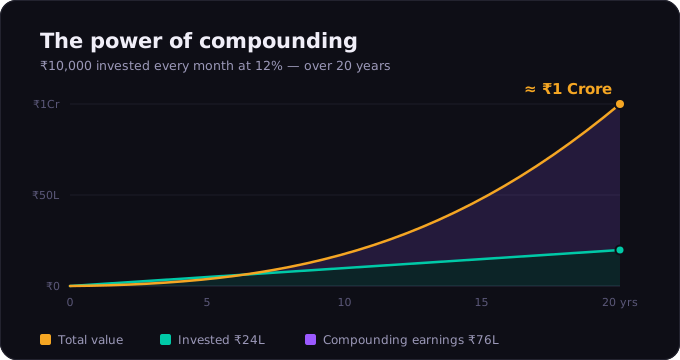
Albert Einstein reportedly called compound interest the "eighth wonder of the world." Whether or not he actually said it, the mathematics deserve the reverence. Compound interest is the mechanism by which money grows on itself — interest earns interest, which earns more interest — and over long periods, the effect becomes almost magical. This guide walks through exactly how it works.
Simple vs Compound Interest
Understanding the difference starts with a clear example:
Simple interest: ₹1,00,000 at 10% for 5 years.
Each year you earn ₹10,000 interest. After 5 years: ₹1,50,000.
Compound interest (annual): Same amount, same rate.
Year 1: ₹1,00,000 × 1.10 = ₹1,10,000
Year 2: ₹1,10,000 × 1.10 = ₹1,21,000
Year 3: ₹1,21,000 × 1.10 = ₹1,33,100
Year 4: ₹1,33,100 × 1.10 = ₹1,46,410
Year 5: ₹1,46,410 × 1.10 = ₹1,61,051
Compound interest earns ₹11,051 more over 5 years — and that gap widens dramatically over longer periods.
The Compound Interest Formula
- A = Final amount
- P = Principal (initial investment)
- r = Annual interest rate (as a decimal, e.g. 8% = 0.08)
- n = Number of compounding periods per year (12 for monthly, 4 for quarterly, 1 for annual)
- t = Time in years
Compounding Frequency: Monthly Beats Annual
All else equal, more frequent compounding = more money. Here's ₹1,00,000 at 10% for 10 years:
| Frequency | n | Final Amount |
|---|---|---|
| Annual | 1 | ₹2,59,374 |
| Half-yearly | 2 | ₹2,65,330 |
| Quarterly | 4 | ₹2,68,506 |
| Monthly | 12 | ₹2,70,704 |
Monthly compounding earns ₹11,330 more than annual — purely from frequency. Most bank accounts compound monthly or daily.
Adding Monthly Contributions
Most real-world savings aren't a single lump sum — you invest a fixed amount every month (SIP in India, direct debit in the UK, 401k contribution in the US). The formula with regular contributions:
Where M = monthly contribution and r = monthly rate
Example: ₹0 initial, ₹5,000/month SIP, 12% annual (1% monthly), 20 years.
r = 0.01, n = 240
FV = 0 + 5000 × [(1.01)²⁴⁰ − 1] / 0.01
FV = 5000 × [10.893 − 1] / 0.01
FV ≈ ₹49,46,500
Total contributed: ₹5,000 × 240 = ₹12,00,000. Wealth created by compounding: ₹37,46,500 — more than 3× what you invested.
The Rule of 72
A quick mental shortcut: divide 72 by the annual interest rate to find how many years it takes to double your money.
| Rate | 72 ÷ Rate | Actual years to double |
|---|---|---|
| 6% | 12 years | 11.9 years |
| 8% | 9 years | 9.0 years |
| 12% | 6 years | 6.1 years |
| 15% | 4.8 years | 4.96 years |
Starting Early vs Investing More: The Time Proof
This is the most important lesson compound interest teaches:
Person A (Early starter): Invests ₹5,000/month from age 25 to 35 (10 years), then stops. Total invested: ₹6 lakh. Earns 12% p.a. until age 60.
Person B (Late starter): Invests ₹5,000/month from age 35 to 60 (25 years). Total invested: ₹15 lakh. Same 12% p.a.
At age 60:
Person A: ~₹1.89 crore
Person B: ~₹94 lakh
Person A has twice the wealth by investing for only 10 years (vs 25 years) — purely because of a 10-year head start. Time is more powerful than the amount invested.
See your savings grow with compound interest
Enter your initial amount, monthly contributions, rate and time — get a year-by-year breakdown with chart.
Open Savings Growth Calculator →Calculations are illustrative and assume constant rates. Actual investment returns vary. Not financial advice.
Official sources
Every rate and threshold in this guide is checked against the official government sources below. Always confirm figures for your own situation before filing.